
News & Insights
Growing Knowledge Beneath the Surface: Woodfibre LNG Supports Local Kelp Restoration Research
Sep 4, 2026
At Woodfibre LNG, environmental stewardship means more than checking off a list of requirements; it means supporting practical, location-specific work that can help improve our understanding of local ecosystems for the long term.
While Woodfibre’s construction is still progressing towards completion in 2027, our habitat restoration and protection efforts will last much longer than that. As long as we’re operating in Átl’ḵa7tsem (Howe Sound), we’ll be considering how we can treat its species, waters, and habitats with the care and respect they deserve.
That’s why we’re proud to be supporting a kelp restoration pilot project in Howe Sound in partnership with the British Columbia Institute of Technology (BCIT) and West Coast Kelp.
Together, we are helping advance marine habitat research near the Woodfibre LNG site while creating valuable hands-on learning opportunities for the next generation of restoration professionals.
Why kelp matters
Kelp is one of the most important habitat-forming species in coastal ecosystems. In Howe Sound, and along the B.C. coast, kelp forests provide food and shelter for a wide range of marine life and play an important role in supporting biodiversity.
Kelp forests are regarded as critical to the survival of coastal ecosystems, but they have declined by over 50 per cent across the last five decades.
For species like herring and juvenile salmon, kelp can provide important refuge, spawning and feeding habitat. Healthy kelp ecosystems also help recycle CO2, can be a source of food and medicines, and support the balance and productivity of coastal waters.
Like many marine habitats around the world, kelp forests in B.C. face growing threats. Rising ocean temperatures, changing shoreline conditions, and grazing from overpopulated species like sea urchins all make it more difficult for kelp to thrive and return on its own.
A local partnership with a practical purpose
This pilot project brings together unique contributions from three partners:
- British Columbia Institute of Technology is leading the research through its restoration program, giving students a rare opportunity to study kelp restoration in a real-world industrial setting. The project’s monitoring and research is led by BCIT faculty member Jamie Slogan, a former consultant for Woodfibre LNG and his first graduate student Sylvie Stewart Grantham.
- West Coast Kelp brings technical expertise in kelp cultivation and nursery operations.
- Woodfibre LNG is supporting the project by providing access, coordination, and the conditions needed to carry out field-based research safely and effectively.
The goal is to better understand how young kelp plants can be grown and nurtured in Howe Sound, using novel methods never tried before in this region.
How the project works
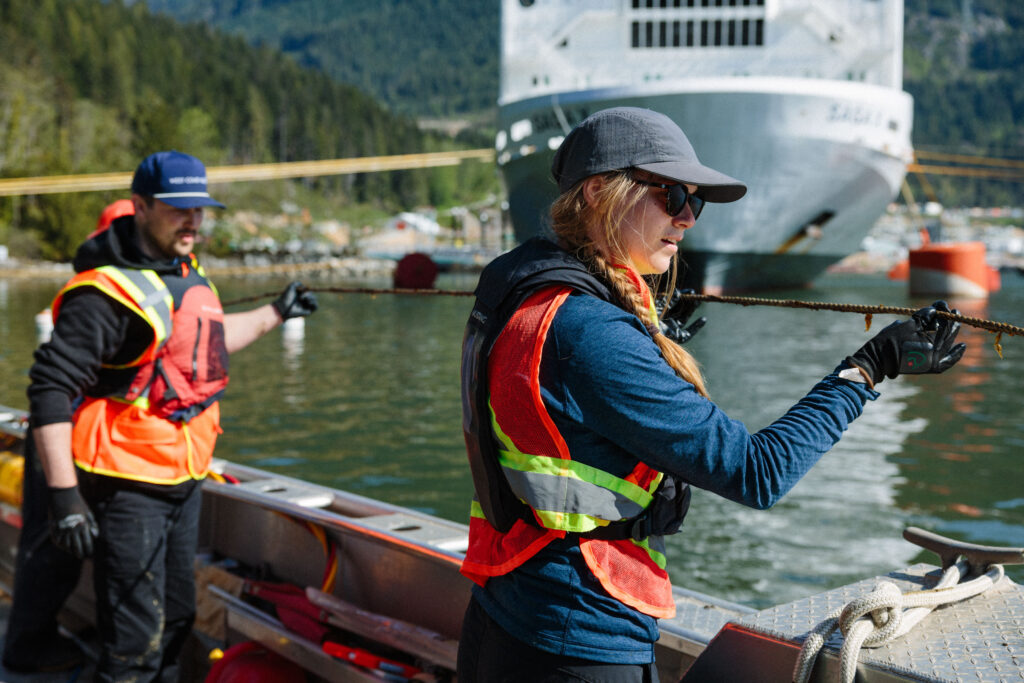
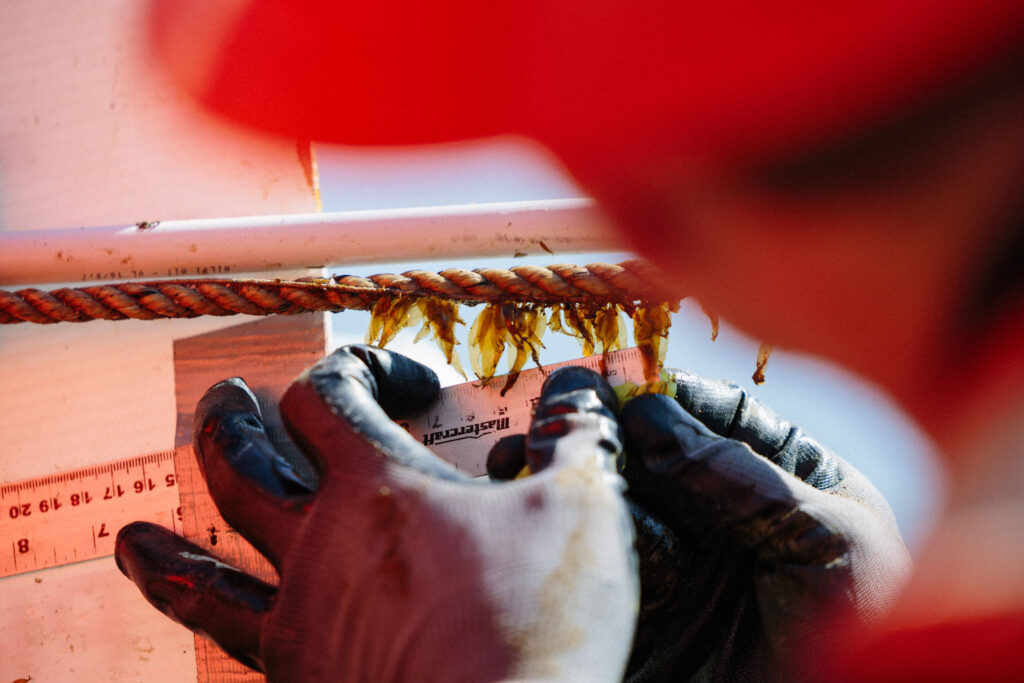
The process begins with reproductive kelp collected from the Woodfibre LNG site. That kelp is then taken to a nursery, where spores are collected and cultivated. They are then added to spools of twine and grown under controlled conditions until the lines are ready to be set in the appropriate ocean conditions.
Growing kelp on long lines allows it to develop above the seafloor, where it is less exposed to grazers such as urchins and snails. In the first year of the project, the kelp got off to a slow but successful start, however, some complications mid-season with the set-up resulted in poor growth. This year the team hopes to hit the right cycle on either side of Christmas.
BCIT aims to test a new approach by moving kelp, once it reaches a suitable size, onto site materials it can attach to, such as man-made rock reefs and cobble blankets (layers of clean sand topped with rounded stones), similar to those planned in the restoration process, as well as suspended lines at the appropriate depth, to provide a stable growing surface.
Learning from the site
One of the most important parts of this work is that it is designed to generate site-specific information.
The Woodfibre LNG site has presented challenges for kelp growth due to factors such as water depth, sediment from the Squamish River, and changing temperature and tidal conditions. In response, the team is examining whether adjusting lab temperatures during cultivation can help improve the kelp’s tolerance to warmer conditions.
Conditions can vary from one shoreline to another, and successful restoration depends on understanding local factors such as depth, substrate, light, water movement, and growth rates. By studying kelp growth directly at the Woodfibre LNG site, the project team can build practical knowledge that supports informed decision-making in the future.
As Sylvie Stewart Grantham put it: “Howe Sound is a unique spot, and so even testing techniques that are successful somewhere else may not be as successful in this location, or vice versa.”
Supporting education and future leaders
This project also reflects the value of collaboration between industry and education.
Through BCIT’s involvement, students are gaining direct experience in restoration research, fieldwork, and applied environmental problem-solving. Opportunities like this are rare and can play an important role in preparing future leaders in marine science and habitat restoration.
We’re proud to help create space for that learning to happen.
Looking ahead
Kelp restoration is an evolving field, and projects like this are an important step in understanding what is possible in local waters.
If successful, the pilot could pave the way for Woodfibre LNG to expand its support for kelp restoration and related research. Jamie Slogan has described BCIT’s work as the first step in a larger marine restoration effort, which has been made possible by Woodfibre LNG’s support. As interest in marine restoration and conservation continues to grow, the project offers a practical starting point for future work in Howe Sound.
John Morgan, Woodfibre LNG’s Vice President of Communications and Sustainability, has called stewardship of these lands and waters a core priority, and described the BCIT partnership as a strong example of industry, aquaculture, and academia working together.
In his words: “Woodfibre LNG is taking a long view when it comes to habitat restoration, and efforts to support thriving ecosystems in Átl’ḵa7tsem (Howe Sound) will continue even after construction is completed. Finding ways to more quickly regrow kelp and establish a cornerstone to a healthy ecosystem will be vitally important in that.”
At Woodfibre LNG, we’re pleased to support initiatives that help build knowledge, strengthen partnerships, and contribute to the long-term health of Howe Sound.
Blog
Blog

Blog