Our Facility
Operating Safely on the Shores of Howe Sound
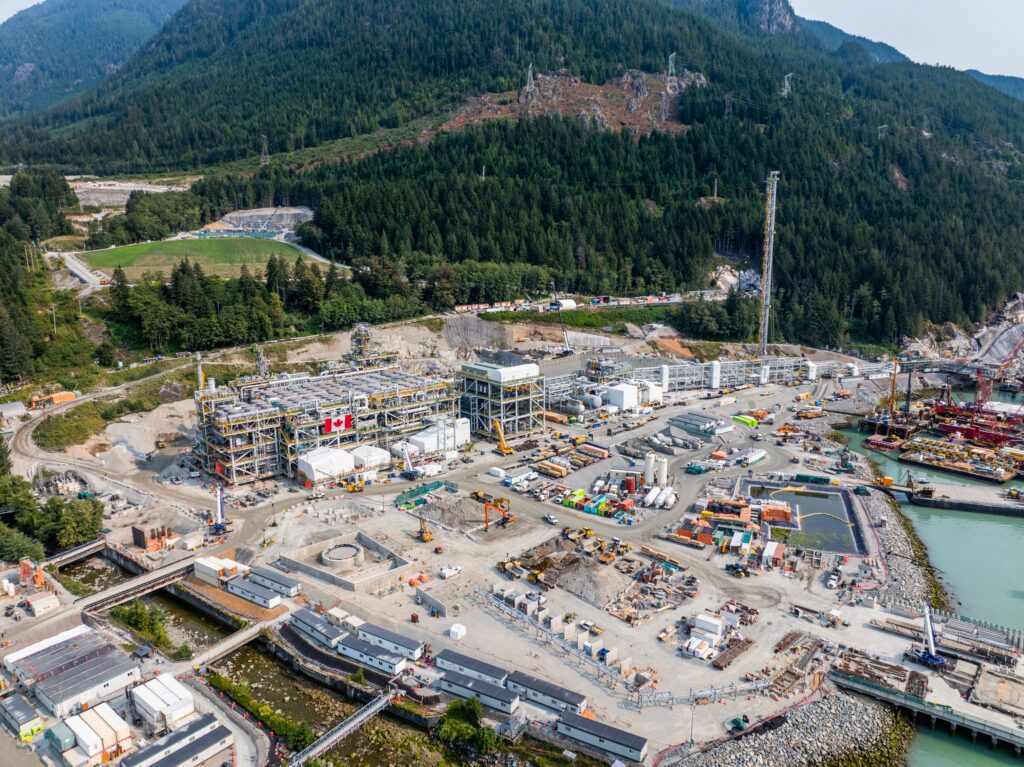
The Woodfibre LNG facility is a natural gas liquefaction and export facility located approximately seven kilometres southwest of Squamish on the historical site of Swiy̓át, a Sḵwx̱wú7mesh Úxwumixw (Squamish Nation) village, in Nexwnéwu7ts Átlḵ’a7tsem (Howe Sound).
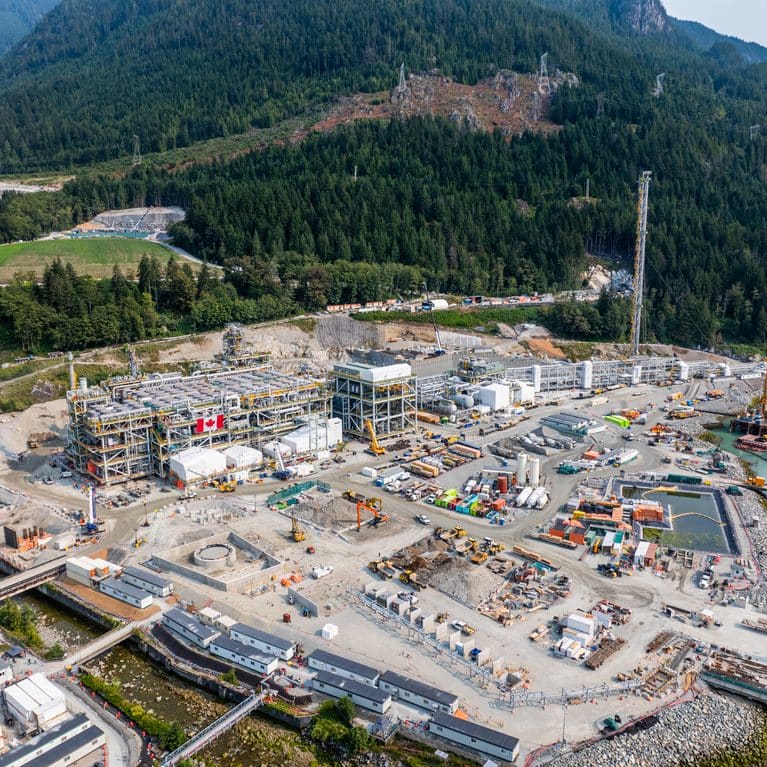
When operations begin, the facility will receive natural gas from British Columbia’s existing pipeline network, cool it into liquefied natural gas (LNG), temporarily store it on site, and load it onto specialized LNG carriers for export to overseas markets.
Designed to produce approximately 2.1 million tonnes of LNG each year, the facility has been engineered to operate safely, efficiently and with one of the lowest greenhouse gas emissions intensities of any LNG export facility in the world.
Powered by renewable hydroelectricity from BC Hydro and using electric-drive compression technology, Woodfibre LNG was the first LNG export facility in Canada approved to use electric compressors instead of conventional gas-powered turbines. Combined with nature-based carbon offsets for hard-to-abate emissions, this supports our commitment to operate as the world’s first net zero LNG export facility.
Throughout operations, the facility will continue to operate under comprehensive federal, provincial and Squamish Nation regulatory oversight, with extensive environmental monitoring, operational management plans and emergency response procedures in place.
What is Liquefied Natural Gas (LNG)?
Natural gas is primarily composed of methane. When it is cooled to approximately -162°C, it changes from a gas into a liquid.
In this liquid form:
- LNG occupies approximately 1/600th the volume of natural gas.
- It can be safely stored and transported in insulated, non-pressurized tanks.
- It is colourless, odourless, non-toxic and non-corrosive.
Liquefaction makes it possible to transport natural gas efficiently to markets that are not connected by pipelines. Once it reaches its destination, LNG is converted back into natural gas at a receiving terminal before being delivered to homes, businesses and industries through local pipeline systems.
How the Woodfibre LNG Facility Works
Producing LNG involves several carefully controlled steps that transform pipeline-quality natural gas into a liquid for safe storage and export.
Natural Gas Delivery
Natural gas arrives at the facility through the Eagle Mountain – Woodfibre Gas Pipeline Project, an extension of FortisBC’s existing pipeline system.
Because the gas already meets pipeline-quality specifications, only limited processing is required before liquefaction.
Gas Conditioning
Before liquefaction, the natural gas passes through equipment that removes any remaining trace impurities and prepares it for cooling. Since the incoming gas is already processed to pipeline standards, this stage is relatively simple compared to many LNG facilities.
Liquefaction
The natural gas is cooled using a refrigeration process until it reaches approximately -162°C, where it becomes a liquid.
Cooling the gas dramatically reduces its volume, making it practical to store and transport by ship.
Woodfibre LNG operates a single liquefaction train, an approach that matches the project’s compact footprint while producing up to 2.1 million tonnes of LNG annually.
Unlike most LNG facilities around the world, Woodfibre LNG uses electric-drive compressors powered by BC Hydro’s renewable electricity instead of gas-powered turbines, significantly reducing operational greenhouse gas emissions.
LNG Storage
Once liquefied, the LNG is transferred into insulated floating storage units moored at the facility.
Using modified LNG carriers for storage allows Woodfibre LNG to reduce the amount of permanent infrastructure required on site while safely maintaining LNG at its cryogenic temperature until it is ready for export.
Loading LNG Carriers
When an LNG carrier arrives, LNG is transferred from storage using specialized cryogenic loading equipment designed for safe operations.
On average, one LNG carrier will visit the facility approximately every 10 days.
Export
The LNG carrier transports the product across the Pacific to overseas receiving terminals.
Modern LNG carriers use advanced containment systems to maintain the LNG at its low temperature during transit and are sometimes powered using natural gas from their own cargo, improving fuel efficiency.
Regasification
At its destination, LNG is warmed and converted back into natural gas before entering local pipeline systems for use in electricity generation, industrial processes, heating and other applications.
Electric Drive Technology
One of the defining features of the Woodfibre LNG facility is its use of electric-drive compressors.
Traditional LNG facilities typically rely on large natural gas turbines to power their liquefaction process. These turbines are generally the largest source of greenhouse gas emissions at an LNG facility.
Woodfibre LNG instead uses electric-drive compressors powered by renewable hydroelectricity supplied by BC Hydro.
This technology offers several advantages:
- Significantly lower greenhouse gas emissions.
- Higher energy efficiency than conventional gas turbines.
- Greater operational precision and flexibility.
- Reduced maintenance requirements and improved equipment reliability.
The use of electric-drive technology is a key reason Woodfibre LNG is expected to have one of the lowest operational emissions intensities of any LNG export facility in the world.