
News & Insights
Supporting Royal Canadian Marine Search and Rescue, Station 4 Squamish
Sep 2, 2026
On the waters of Howe Sound, conditions can change quickly.
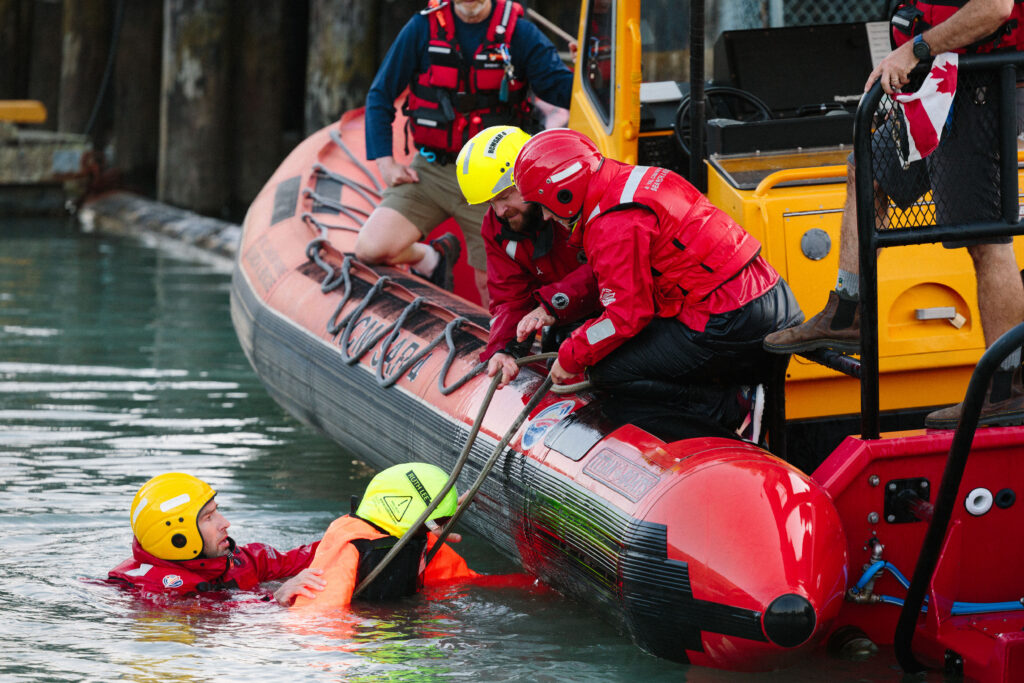
For the volunteers of Royal Canadian Marine Search and Rescue (RCMSAR) Station 4 in Squamish, being ready for those moments means training, preparation and teamwork long before an emergency call comes in. Last month we had the opportunity to join this dedicated group of volunteers for one of their weekly training exercises as they put some new equipment, funded by a recent donation from Woodfibre LNG, to the test.
The Royal Canadian Marine Search and Rescue in Squamish is a volunteer-run marine search and rescue station serving Squamish and Howe Sound. While the station experiences a medium volume of calls compared with some of RCMSAR’s busiest stations, it has no shortage of people willing to help. Year after year, more volunteers apply than there are positions available. The Squamish station is also a provincial leader in diversity, with nearly 50 per cent female crew members.
Each volunteer contributes upwards of 200 hours a year. New crew members train for approximately one year to reach the basic rescue crew standard, while advanced crew members and coxswains can train for two to three years. That commitment helps keep the station ready to respond 24 hours a day, 365 days a year, often at a moment’s notice.
Like many volunteer organizations, RCMSAR’s Station 4 relies on fundraising and community support to provide its crews with the equipment and resources they need.
Woodfibre LNG has supported RCMSAR in Squamish annually for the past 10 years. Most recently, Woodfibre LNG provided $25,000, the largest corporate donation the station has received, to support new equipment and training resources.
The funding has helped purchase a new radar system for the station’s rescue vessel, a rescue mannequin for training exercises, a vacuum spine boardand Manta search and rescue helmets for its volunteer crew. On paper, they’re pieces of equipment. On the water, they make a meaningful difference.
The radar helps crews navigate safely when visibility is limited. The rescue mannequin allows volunteers to practice realistic scenarios and build skills they’ll rely on during an emergency and the specialized helmets help protect crew members during training and rescue operations.
With Woodfibre LNG constructing and operating on Howe Sound, marine safety is an important area of focus. RCMSAR plays an important role inkeeping these waters safe for everyone who uses them.
Over the past decade, Woodfibre LNG’s support for RCMSAR has helped build an ongoing relationship focused on marine safety and supporting the volunteers who respond when help is needed on Howe Sound.
For the volunteers of RCMSAR in Squamish, that preparation starts long before they leave the dock.
If you’re also interested in supporting the volunteers who help save lives on the water in Squamish, donate here to the Royal Canadian Marine Search and Rescue, in Squamish.
Blog
Blog
Blog