Frequently Asked Questions
What to Know About Flaring at Woodfibre LNG
Flaring is a routine and important safety function at LNG facilities. These FAQs explain why flaring occurs at Woodfibre LNG, what neighbouring communities may see, hear or smell, and how flaring is managed, monitored and regulated.
Understanding flaring
What is flaring?
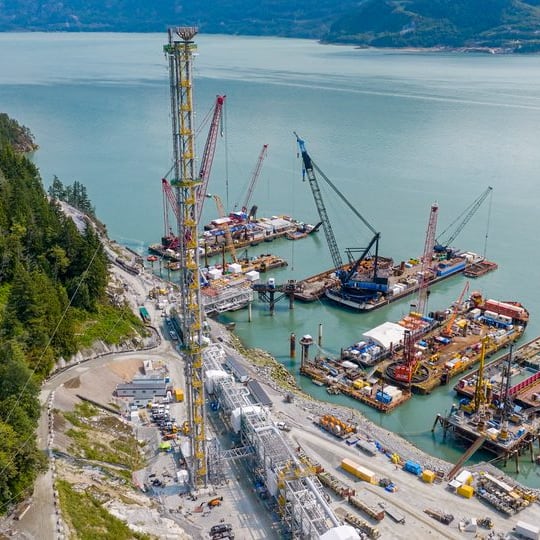
Flaring is a controlled, built-in process to safely burn excess natural gas or other hydrocarbons during certain operating conditions. It is a routine part of operating an LNG facility. The flare acts as a pressure-relief and gas-disposal system during commissioning, startup, shutdown, maintenance and some unplanned events.
Why does Woodfibre LNG need to flare?
Natural gas moves through the facility under pressure. At times, gas must be removed so equipment can be started, stopped, maintained or safely depressurized, including in response to unexpected events. The flare provides a controlled way to manage that gas.
Without it, pressure could build to levels that are unsafe for workers or damage equipment, or gas would need to be vented directly to the atmosphere. Flaring is required under applicable industrial design codes and standards.
Why flare gas instead of releasing it directly into the atmosphere?
The primary byproducts of burning methane during flaring are carbon dioxide and water. Methane is a more potent greenhouse gas than carbon dioxide, so burning excess natural gas, even imperfectly, releases significantly fewer greenhouse gases than releasing it directly into the atmosphere.
What type of gas is burned in the flare?
Most gas sent to the flare will be domestic-quality natural gas, the same gas commonly used in homes for heating, fireplaces and gas stoves. Under certain operating conditions, other hydrocarbons used in the LNG process, including propane or ethane refrigerants, may also be sent to the flare.
How does the flare system work?
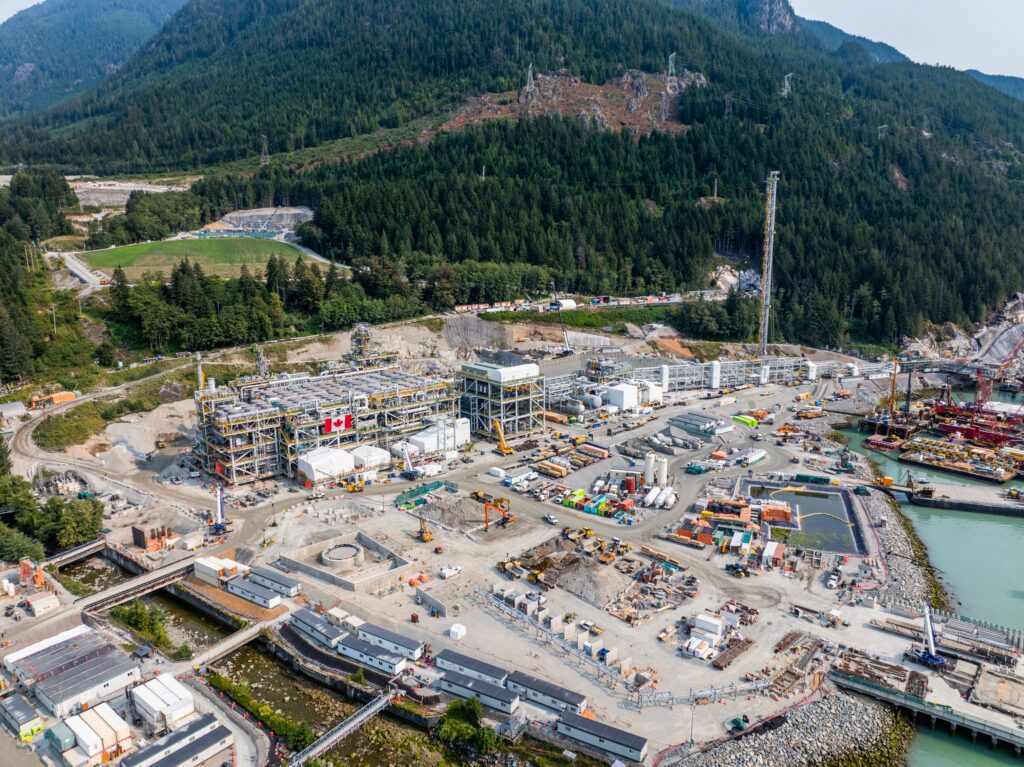
Woodfibre LNG has one 134-metre flare stack with two flare systems, one high-pressure and one low-pressure, each with its own flare tip. From a distance, the two tips appear as a single flare. The systems are connected to pressure-relief and process systems throughout the facility. When gas needs to be safely removed, it is directed through piping to the appropriate flare system, where a continuously lit pilot flame ignites it at the flare tip.
Will the flare burn all the time?
No. A small pilot flame, up to about one metre tall, will remain continuously lit so the flare is ready when needed. It may not be visible from a distance, and a lit pilot does not mean a flaring event is happening or about to happen. Larger visible flames occur only when gas is being sent to the flare.
What is the difference between planned and unplanned flaring?
Planned flaring occurs during scheduled activities such as commissioning, startup, maintenance or short-term facility shutdowns. For planned flaring above applicable regulatory thresholds, communities will be notified at least 24 hours in advance.
Unplanned flaring can occur in response to an unexpected operating condition, such as equipment malfunction or loss of power, to keep workers and the facility safe. For unplanned flaring above applicable regulatory thresholds, communities will be notified within 24 hours.
What communities may see, hear or smell
How high could the flame be?
Flame height will depend on the amount of gas being sent to the flare and the operating situation. During commissioning and following some shutdowns and restarts, the flame is expected to average up to 60 metres above the flare tip. In rare emergency situations, it could reach roughly 90 metres for up to 15 minutes.
What will flaring look like?
People with a direct view of the facility, including residents in Britannia Beach and Furry Creek, will see the flame. At night, the glow may also be visible from Squamish, Stá7mes and other nearby communities. Flaring will not produce additional visible light during the day.
Weather can affect visibility. Wind may bend the flame, and cloud cover can make the nighttime glow more noticeable.
How bright could the flare be at night?
Modelling predicts that light from some nighttime flaring events may be noticeable in nearby communities. In Britannia Beach, about five kilometres from the facility, modelled light levels could reach approximately 5.4 lux under cloud cover, comparable to a dimly lit parking lot. For comparison, a typical streetlight is 10 to 15 lux.
What will flaring sound like?
Sound will vary with the volume and flow rate of gas, distance from the facility, background noise and weather. Modelling predicts flaring could add about 1 to 6 decibels (dB) to existing sound levels in surrounding communities. For reference, a 1–2 dB increase is generally not noticeable, while an increase above 5 dB may be perceptible.
In Squamish, Stá7mes and Darrell Bay, the increase is unlikely to be noticeable over background noise. In Britannia Beach, it may be noticeable in calm, quiet nighttime conditions, especially with windows open, and may sound like the low hum of a fridge compressor.
Will there be an odour from flaring?
Odour from flaring is not expected in surrounding communities, but it may be detectable closer to the facility. Odour can occur when heavier hydrocarbons are present in the gas being flared, and may smell similar to engine exhaust from a car.
Will there be black smoke?
Woodfibre LNG’s flare is designed to burn with little or no visible smoke under most operating conditions. Black smoke can occur when heavier hydrocarbons, such as propane or ethane refrigerants, are not completely burned. It is expected during specific commissioning events and could occasionally occur during operations, such as during a process upset.
The high-pressure flare uses a multi-nozzle flare tip designed to improve gas-air mixing and reduce the likelihood of black smoke.
Commissioning and operations
Why does flaring occur during commissioning?
Commissioning is when equipment and systems are tested and progressively brought into service. Natural gas is introduced into different parts of the facility so equipment, processes and safety systems can be tested under operating conditions.
Because many systems are being started and tested for the first time, flaring is expected to be more frequent and last longer during commissioning than during steady-state operations. More frequent or visible flaring during this time does not mean anything is wrong; it reflects that systems are being tested and brought safely into service.
How often and for how long could flaring occur during commissioning?
Commissioning is expected to begin in mid-2027 and take approximately six to eight months. During this time, flaring will often occur several days a week, with individual events lasting from less than 15 minutes to more than a week.
The exact timing of individual events will depend on which systems are being commissioned and how they perform as they are brought online.
How will flaring change once the facility is operating?
After commissioning, the facility will enter approximately two years of stabilizing operations, while equipment is fine-tuned. Flaring may be more frequent during this time but is expected to gradually decrease.
Once the facility reaches steady-state (normal) operations, flaring is expected to be occasional, likely less than once a month, and primarily associated with startup, shutdown, maintenance or unplanned events.
What happens if commissioning takes longer than expected?
Woodfibre LNG will provide updated information to the BC Energy Regulator, Sḵwx̱wú7mesh Úxwumixw and neighbouring communities if expected commissioning timelines change.
Managing and minimizing flaring
How does Woodfibre LNG minimize flaring?
Woodfibre LNG’s goal is to keep flaring to the minimum needed for safe operations. It has developed a BC Energy Regulator-approved Flaring Management Report with approximately 20 mitigation measures.
Measures include flare-tip technology designed for more complete combustion, systems to reuse and recycle gas where possible, and electric-driven compressors that require less maintenance and fewer shutdowns than gas-powered compressors. During commissioning, equipment will be dried out using imported nitrogen rather than gas that would need to be flared, and valves will be tested before commissioning to ensure they seal tightly.
Can flaring be eliminated completely?
No. The flare is a critical safety system that is required by law and must remain available to safely manage gas during certain operating conditions. Woodfibre LNG will reuse and recycle gas where possible and minimize both the duration of flaring and the quantity of gas flared.
Regulation and monitoring
How is flaring regulated in British Columbia?
Flaring at LNG facilities in B.C. is governed by the Energy Resource Activities Act and the Liquefied Natural Gas Facility Regulation, administered by the BC Energy Regulator (BCER). These requirements establish when flaring may occur and require operators to minimize both the duration of flaring and the quantity of gas flared. Operators must also keep a log of all flaring activity and notify the BCER about planned and unplanned flaring events above set thresholds.
How are air emissions from flaring regulated?
Woodfibre LNG is applying to the BC Energy Regulator (BCER) for a Waste Discharge Authorization (WDA) for air emissions under B.C.’s Environmental Management Act.
The WDA will set enforceable limits and requirements for facility air emissions, including emissions from routine flaring, along with monitoring and reporting requirements. The permit will not include limits for unplanned flaring, which is needed to safely manage gas during unexpected process interruptions. The application process includes a public comment period.
How will flaring and air quality be monitored?
Woodfibre LNG will measure air emissions from the facility, including the flare system, and regularly report them to the BC Energy Regulator (BCER). The BCER will also require Woodfibre LNG to monitor air quality in the surrounding environment. An Air Quality Mitigation and Monitoring Plan will be in place before flaring begins and will include the monitoring requirements in the facility’s Waste Discharge Authorization (WDA).
An existing air quality monitoring station in Squamish already measures local air quality, and additional community-based monitoring is being considered. Woodfibre LNG will also keep a log of all flaring activity, as required by regulation.
What happens if black smoke exceeds a regulatory threshold?
There is no black smoke threshold during commissioning or emergencies, which are temporary events to test systems or respond to unexpected conditions. Black smoke is not permitted during planned flaring in operations. During an unplanned flaring event, such as a process upset, black smoke is not permitted for more than 15 minutes in any two-hour period.
If a threshold is exceeded, Woodfibre LNG would be required to report the non-compliance to the BC Energy Regulator, take steps to mitigate the black smoke and bring the facility back into compliance as quickly as possible.
Air quality, health and wildlife
What emissions are produced during flaring?
The main products of burning domestic-quality natural gas are carbon dioxide (CO₂) and water. CO₂ is a greenhouse gas but not an air pollutant that affects air quality. Flaring also produces very small amounts of other combustion byproducts, including nitrogen oxides, fine particulate matter, sulphur dioxide, carbon monoxide and volatile organic compounds. These are assessed in Woodfibre LNG’s air quality modelling and regulatory permitting.
How could flaring affect air quality in nearby communities?
Air quality modelling assessed emissions from Woodfibre LNG, including flaring, across a 40 km by 40 km area using five years of local weather data. The highest predicted concentrations occur at or near the facility and decrease rapidly with distance. In surrounding communities, predicted levels remain well below B.C.’s Air Quality Objectives, which are designed to protect human health and the environment.
Does flaring pose a health risk to people in nearby communities?
Woodfibre LNG’s air quality and human health assessments considered facility emissions, including flaring. The modelling shows predicted concentrations in surrounding communities remain below health-based thresholds across every scenario assessed, including commissioning, steady-state operations and unplanned events. This means human health risk in nearby communities is expected to be negligible.
How could flaring affect wildlife?
Potential effects from flare light, noise, heat and emissions have been assessed. The greatest potential risks are to birds during nighttime migration and to birds or bats that may approach the flare. Potential effects on mammals, marine mammals and fish are expected to be low.
Where safe and feasible, planned flaring will be scheduled to reduce overlap with sensitive wildlife periods, such as avoiding nighttime flaring during peak bird migration. Woodfibre LNG is developing an Operations Wildlife Management and Monitoring Plan in consultation with Sḵwx̱wú7mesh Úxwumixw, and monitoring results will be used to inform its approach over time.
Keeping communities informed
How will communities be informed about flaring?
For planned flaring above regulatory thresholds, communities will be notified at least 24 hours in advance, including expected timing, duration and estimated flame height. For unplanned flaring above regulatory thresholds, a notification will be issued within 24 hours, with information on expected duration and how the situation is being managed.
Where can I find current information or ask questions?
Current information about flaring and facility operations will be available on the Woodfibre LNG website and social media channels. Questions or feedback can be sent to [email protected].