Air Quality Monitoring
From Modelling to Monitoring
Air quality modelling helps us understand what emissions to expect from our operations, including flaring. Once flaring begins, monitoring will measure actual conditions and compare them with those predictions.
Woodfibre LNG will measure facility emissions, monitor air quality in the surrounding environment and report information to regulators in accordance with regulatory requirements. Woodfibre LNG is committed to transparent communication about flaring and flare reporting.
What Will Be Monitored?
Air quality monitoring will look at both emissions from the Woodfibre LNG facility and air quality in the surrounding environment.
Facility emissions
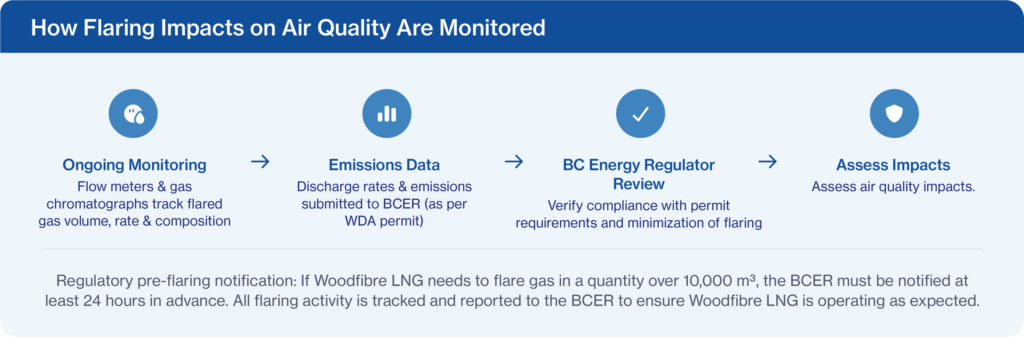
Flow meters and gas chromatographs will track the volume, rate and composition of gas flared, supporting accurate emissions reporting.
Air quality
Air quality monitoring looks at the concentrations of air contaminants in the surrounding environment. This provides information that can be used to understand environmental conditions during facility operations and verify performance against regulatory requirements.
Woodfibre LNG’s air quality modelling has assessed pollutants including nitrogen oxides (NOx), sulphur dioxide (SO₂), fine particulate matter (PM₂.₅), carbon monoxide (CO) and volatile organic compounds (VOCs).
The specific parameters included in Woodfibre LNG’s monitoring program will be established through the Waste Discharge Authorization and Air Quality Mitigation and Monitoring Plan.
Where Will Air Quality Be Monitored?
Baseline information helps establish existing environmental conditions and provides a point of comparison for monitoring during operations. For Woodfibre LNG’s air quality modelling, baseline conditions were established using data from the existing provincial air monitoring station in Squamish and other available monitoring data from representative locations in British Columbia.
The Squamish station currently measures local air quality, including nitrogen dioxide (NO₂), SO₂, PM₂.₅ and ozone (O₃). This data is publicly available through the B.C. Ministry of Environment and Parks.
During commissioning and operations, Woodfibre LNG will monitor air quality in the surrounding environment in accordance with requirements established through its Waste Discharge Authorization and incorporated into its Air Quality Mitigation and Monitoring Plan.
Additional information about monitoring locations, pollutants and other program details will be shared as the monitoring program is finalized.
Who Provides Oversight?
Flaring and air emissions at Woodfibre LNG are subject to regulatory oversight.
The BC Energy Regulator (BCER) will establish requirements for facility air emissions and environmental monitoring through Woodfibre LNG’s Waste Discharge Authorization. Woodfibre LNG will be required to measure air emissions from facility sources and monitor air quality in the surrounding environment.
Sḵwx̱wú7mesh Úxwumixw (Squamish Nation) is an environmental regulator on this project, stemming from the Squamish Nation Environmental Assessment Agreement (SNEAA), the first legally binding Indigenous-led environmental assessment of a project in Canada. Woodfibre LNG regularly engages with Sḵwx̱wú7mesh Úxwumixw on flaring and flaring mitigations.
In accordance with the B.C. Environmental Assessment Certificate, Woodfibre LNG’s Air Quality Mitigation and Monitoring Plan is being developed in consultation with the BCER, Sḵwx̱wú7mesh Úxwumixw, the B.C. Ministry of Environment and Parks, the B.C. Ministry of Health, Vancouver Coastal Health and Tsleil-Waututh Nation.
Public Reporting
Once commissioning begins, Woodfibre LNG will report flaring, air emissions and monitoring data to the BC Energy Regulator in accordance with regulatory requirements. Annual greenhouse gas reports, prepared under the Greenhouse Gas Emissions Reporting Regulation, will be publicly available.
Communities will be notified at least 24 hours before planned flaring events above regulatory thresholds, and within 24 hours of unplanned flaring events above regulatory thresholds.
Details about how monitoring information will be shared will be provided as the monitoring program is finalized.