News & Insights
When Nations Decide: What We Heard at the First Nations Major Projects Coalition Conference
May 9, 2026
At this year’s First Nations Major Projects Coalition (FNMPC) Conference, one theme came through clearly: better projects are built through better relationships.
Woodfibre LNG was invited to take part in a panel titled “When Nations Decide: Indigenous-Led Regulators and Better Projects.” The discussion featured Sxwíxwtn, Wilson Williams, Council Chairperson, Sḵwx̱wú7mesh Úxwumixw (Squamish Nation); Xalek/Sekyu Siyam, Chief Ian Campbell, Hereditary Chief of the Squamish Nation; and Luke Schauerte, CEO of Woodfibre LNG, and was moderated by Kimberly Lavoie (Qalipu First Nation), Assistant Deputy Minister at Natural Resources Canada. The discussion focused on the partnership between Squamish Nation and Woodfibre LNG, and how that relationship has shaped a model for Indigenous-led environmental regulation in practice.
A space for dialogue—and for listening
The FNMPC Conference creates space for Indigenous Nations, industry, and governments to engage directly. That matters in a project environment that is often complex, and where assumptions about timelines, risk, and decision-making can shape outcomes early.
What came through in this panel is that many of those assumptions are being tested.
There is still hesitation in some corners about Indigenous-led processes—concerns about timelines, uncertainty, or overlapping jurisdiction. But the experience shared by Squamish Nation and Woodfibre LNG points in a different direction: when Nations are directly involved as decision-makers, projects can move forward with greater clarity and fewer surprises.
Indigenous-led assessment in practice
Squamish Nation chose to conduct its own environmental assessment for the Woodfibre LNG Project. This decision came from a clear need: existing federal and provincial processes did not fully reflect Squamish Nation’s values, laws, or environmental priorities.
In response, Squamish Nation established a consent-based process that integrates Indigenous knowledge and Western science. The result was the Squamish Nation Environmental Assessment Agreement (SNEAA)—a legally binding framework that sets out how the project is assessed, approved, and regulated.
Through this process, Squamish Nation issued 25 legally binding conditions. These conditions were developed through extensive engagement with Squamish Nation members and reflect environmental, cultural, social, and economic priorities.
They also directly shaped the project.
How the partnership shaped the project
From the outset, the approach was relationship-first. Before major design decisions were finalized, Woodfibre LNG worked with Squamish Nation to understand priorities and incorporate them into the project.
That work is reflected in several key outcomes:
- Air cooling technology was selected over seawater cooling to reduce impacts on Howe Sound
- Electrification supports lower-emission operations at the facility
- Worker accommodation strategies, including a floatel, reduce pressure on local housing
- Gender safety measures and cultural protections are embedded in project planning and operations
These measures were built into the project through the conditions established by Squamish Nation.
The agreement also establishes ongoing oversight. Conditions are monitored and enforced throughout construction and operations, with clear processes for addressing issues as they arise.
Environmental work in Howe Sound
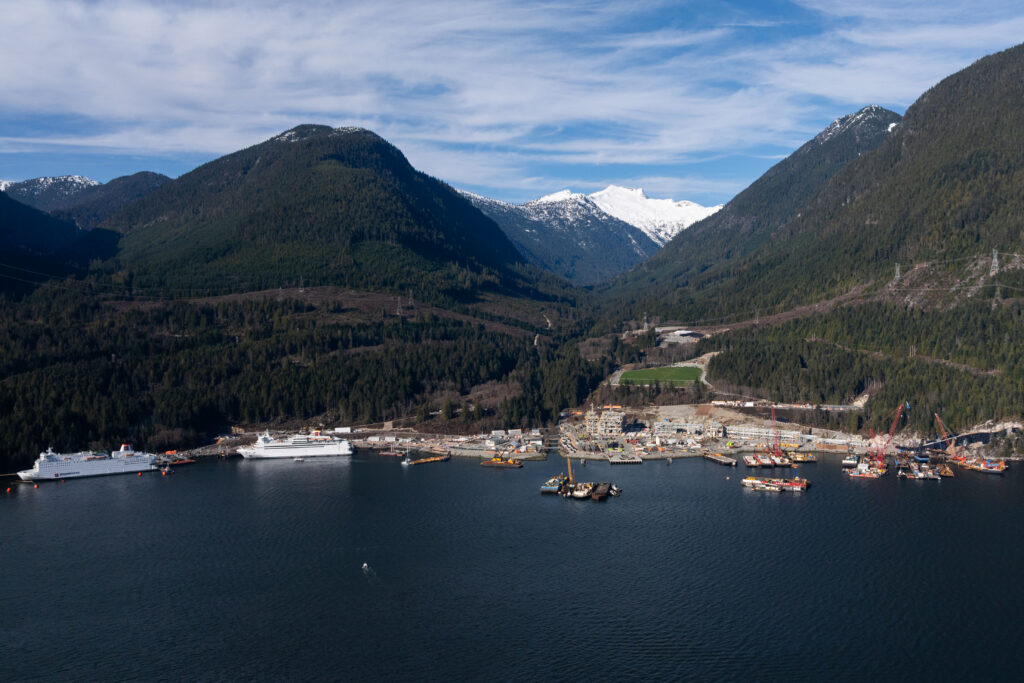
The Woodfibre LNG Project is located on a former pulp mill site. Redeveloping this brownfield site has included significant remediation work.
In partnership with Squamish Nation, this has involved removing legacy industrial infrastructure from the foreshore, addressing historical contamination, and supporting the broader recovery of the Howe Sound ecosystem.
These efforts are part of a longer-term trend in Howe Sound, where marine life—including herring and marine mammals—has been returning after decades of industrial impact.
The project contributes to this work by ensuring that new development meets and exceeds current environmental standards and is subject to ongoing monitoring and oversight.
Reducing uncertainty through collaboration
One of the most consistent messages from the panel was that early alignment reduces downstream risk.
Consent-based processes are sometimes viewed as adding complexity. In practice, the experience shared at the conference suggests the opposite: when expectations are clearly defined upfront, and when Nations are directly involved in decision-making, projects benefit from clearer regulatory pathways, fewer disputes and delays, and more durable outcomes over the life of the project.
This requires time and effort early in the process—particularly in building relationships and working through complex issues. But it also creates a stronger foundation for construction and operations.
Looking ahead
The Squamish Nation Environmental Assessment Agreement is one example of how Indigenous-led regulation can work in practice. It reflects a broader shift in how major projects are developed in Canada—one that recognizes Indigenous jurisdiction, integrates different knowledge systems, and prioritizes long-term environmental stewardship.
For Woodfibre LNG, this approach continues to guide how we move forward. Our partnership with Squamish Nation is active and ongoing, with shared accountability for meeting the conditions set out in the agreement and for ensuring the project is developed responsibly.
Closing takeaway
The discussion at the FNMPC Conference reinforced a clear point: responsible project development depends on who is involved in decision-making, and how those decisions are made.
In the case of Woodfibre LNG, working in partnership with Squamish Nation—and under a framework where Squamish Nation plays a regulatory role—has shaped a project that reflects shared priorities, clear expectations, and ongoing oversight.
That model is already in practice. And it is helping demonstrate how major projects can move forward while supporting environmental protection and strong communities.

Blog
Blog

Blog