News & Insights
LNG Journal: Design‑level decarbonisation and habitat preservation strategies on the path to the world’s first net‑zero LNG export facility
Mar 19, 2026
The following article originally appeared in the LNG Journal on Thursday March 12, 2026.
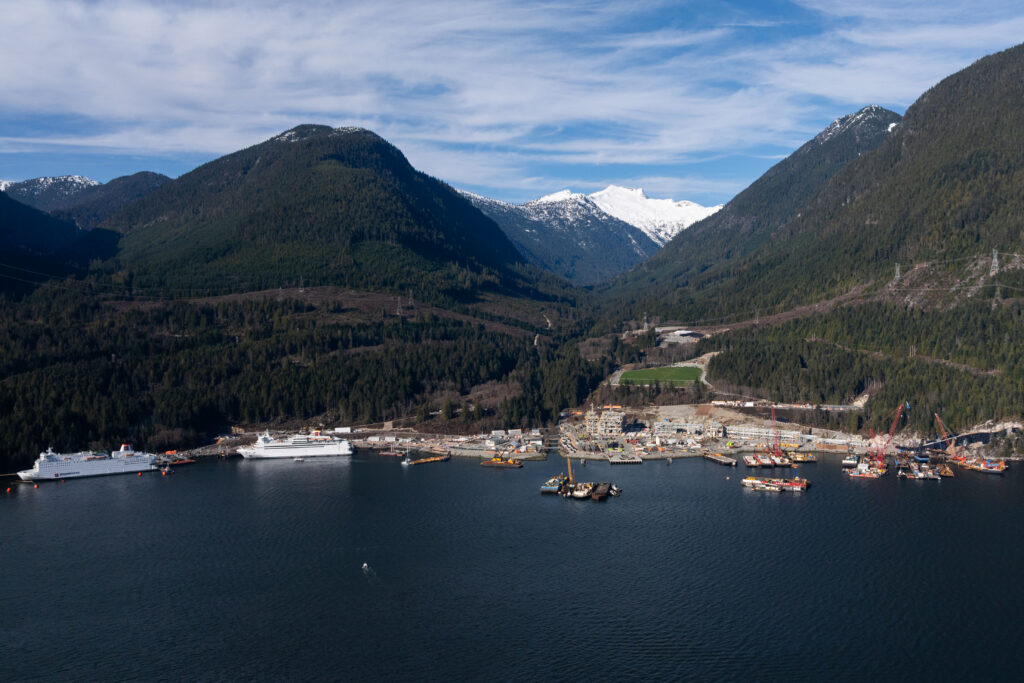
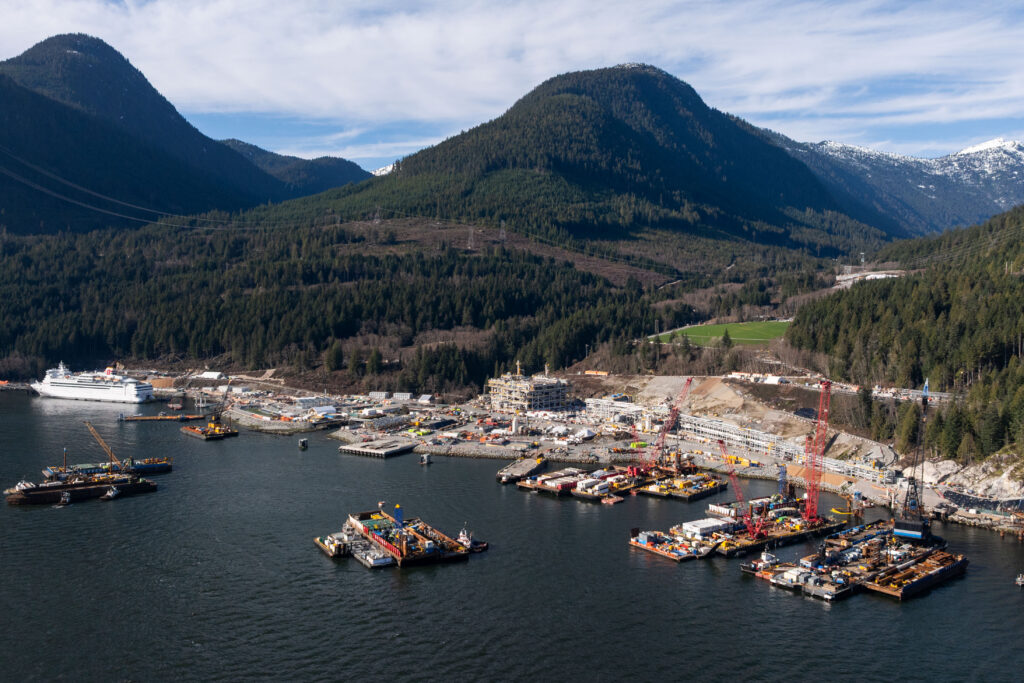
Situated on the former Woodfibre pulp‑mill site in Nexwnéwu7ts Átlk’a7tsem (Howe Sound), the Woodfibre LNG project has recently passed the mid‑point in its construction programme, with around 60% of physical works completed. Woodfibre LNG is a project defined by a series of industry firsts. Not only is it a modular LNG terminal designed to deliver fully electrified, net zero liquefaction at commercial scale, but it is also the first major industrial development in Canada to have a non-treaty First Nation serve as an environmental regulator.
Woodfibre LNG’s unique relationship with the Skwxwú7mesh Úxwumixw (Squamish Nation), ensures the project advances in close alignment with the Nation’s priorities and values, blending industrial progress with cultural respect and environmental stewardship.
Project progress
Fourteen of the nineteen primary process and utility modules have now arrived on site. Module deliveries began last May, with additional modules, including most recently the Pretreatment module and Process Utility Module, arriving through early 2026.
Marine construction is continuing alongside onshore work, including pile installation to support the floating storage tanks mooring system. With a second workforce accommodation vessel (floatel) now on site, Woodfibre can now house enough personnel to manage multiple construction fronts at once. As the remaining major modules arrive in 2026, the project will transition into key finish‑phase work: mechanical tie-ins, connecting to the power grid, pre-commissioning and integrating systems ahead of commissioning and start‑up.
To better understand what makes this facility unique in terms of decarbonisation and ecological mitigation, there are four major components:
Point 1: Electrification
The primary way Woodfibre LNG will reduce its emissions is by fully electrifying the facility’s liquefaction and ancillary compression systems. Woodfibre is the first LNG export facility in Canada designed with electric motor drives (E‑Drives) to power refrigerant compressors and the main mechanical functions. Power for the project is sourced from BC’s renewable hydroelectric grid. That choice is not cosmetic: Woodfibre LNG’s facility carbon intensity is at ≈0.04 tCO2e/tLNG, versus a global average of ~0.35 tCO2e/tLNG for a traditional gas-driven facility. The E-Drive system delivers an emission intensity 14 times lower than gas fired systems, which leads to stationary combustion emissions being reduced by 230,470 tCO2e per year.
Electric motors (E-Drives) provide several practical benefits:
- Better performance: They run more efficiently than gas engines across different power levels.
- Simpler systems: They improve lubrication and sealing by removing wet-seal oil systems that can trap hydrocarbons and require venting.
- Lower costs: They require fewer hours for routine maintenance and reduce spare parts inventories.
- Reduced waste: They reduce the need for constant heating and cooling of equipment during starts and stops, which in turn reduces the need to burn off excess gas (flaring) during unexpected issues.
However, electrification also introduces new capital costs and challenges in grid integration and power quality. But these are well understood and outweighed by the facility’s operating life and the company’s commitment to lower emissions.
In short, Woodfibre LNG’s E‑Drive architecture is the cornerstone technical measure that makes the project’s near‑zero operational emissions credible, reduces flaring through improved reliability, and sets a repeatable template for lower‑carbon LNG design.
Point 2: Remediation of Brownfield Site
Before a single module could be set or a pile driven, Woodfibre LNG executed an extensive brownfield remediation program to remove legacy contamination from a former pulp-mill operation. This included removing 471,534 tonnes of contaminated soils, removing creosote-treated marine piles, stabilizing historic waste areas, and helping restore shoreline habitat.
These efforts reduced contaminant pathways into Howe Sound and helped reverse conditions that risked making the area unsuitable for key species, such as Pacific herring.
More than 4,000 creosote‑treated marine piles were removed from the shoreline. Creosote—which is made up of complex polycyclic aromatic hydrocarbons (PAHs) and phenolics—leaves behind bioavailable toxins and has historically made adjacent pilings unsuitable for Pacific herring spawning, since eggs exposed to PAHs become non-viable. Beyond piles and soils, crews removed thousands of tonnes of industrial debris, tires, rebar, concrete mats, and abandoned infrastructure, sorting wastes for recycling, recovery, or regulated disposal.
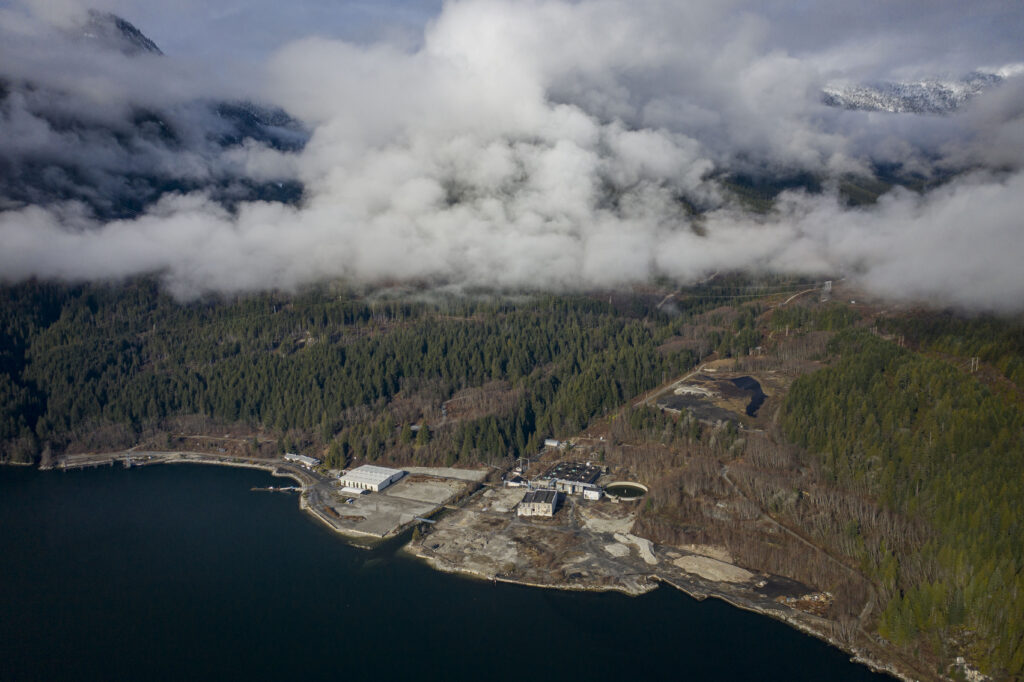
A critical step was capping the site’s former municipal landfill with an engineered multi‑layer cap: an impervious geomembrane cap supported by a foundation of recycled crushed concrete from demolished mill infrastructure and protected on top with a layer of drainage material and topsoil. The cap interrupts flow paths that previously channeled leachate into Howe Sound’s waters. Stormwater and groundwater control measures like sediment basins, oil/water separators, and monitored discharge points were installed to meet provincial water quality criteria. The restoration project used local plants and trees—specifically those that grow near shorelines and hillsides—to help keep the ground firm, minimize erosion, and accelerate the return of a healthy, natural environment.
This remediation and reclamation project reduced contaminant levels in Howe Sound, removed spawning‑substrate hazards for key forage species, and laid the foundations for ecological recovery during construction.
Point 3: Preservation of the Marine Environment
Woodfibre LNG operates in a designated UNESCO biosphere, which means there is greater responsibility to minimize noise, maintain clear waters, and reduce pollution in the surrounding ecosystem. The construction process has been designed based on proven low‑impact marine engineering practices and a comprehensive monitoring and mitigation regime.
Woodfibre uses bubble curtains, vibratory pile driving, and continuous hydro-acoustic monitoring to reduce and track underwater noise. If rock removal is required, activities are carefully timed and controlled behind the bubble curtains to reduce the reach of underwater pressure waves and protect the surrounding environment. Peak sound‑pressure level (SPL) modelling guides the staging so that Root Mean Square energy (RMS) stay below fisheries‑compliance levels at designated monitoring stations.
Acoustic mitigation and monitoring are central to Woodfibre LNG’s approach. The project operates a sophisticated marine monitoring system that combines visual observers on the shore, marine mammal observers (MMOs) on vessels, thermal/night‑vision optics, and an array of passive acoustic monitoring (PAM) hydrophones. PAM enables continuous, real‑time detection of sounds from marine mammals and can automatically trigger spectrogram analyses to identify which species the sound comes from (e.g., transient vs. resident orcas, humpback tonal patterns, and more). Regulators receive acoustic metrics such as SPLpeak (dB re 1 μPa) and SPLrms, which also inform operational decisions. Construction activities follow strict red‑light go/no‑go criteria at the fisheries‑compliance and pinniped‑compliance stations, with predefined exclusion radii and conservative shutdown rules whenever sightings occur within these zones.
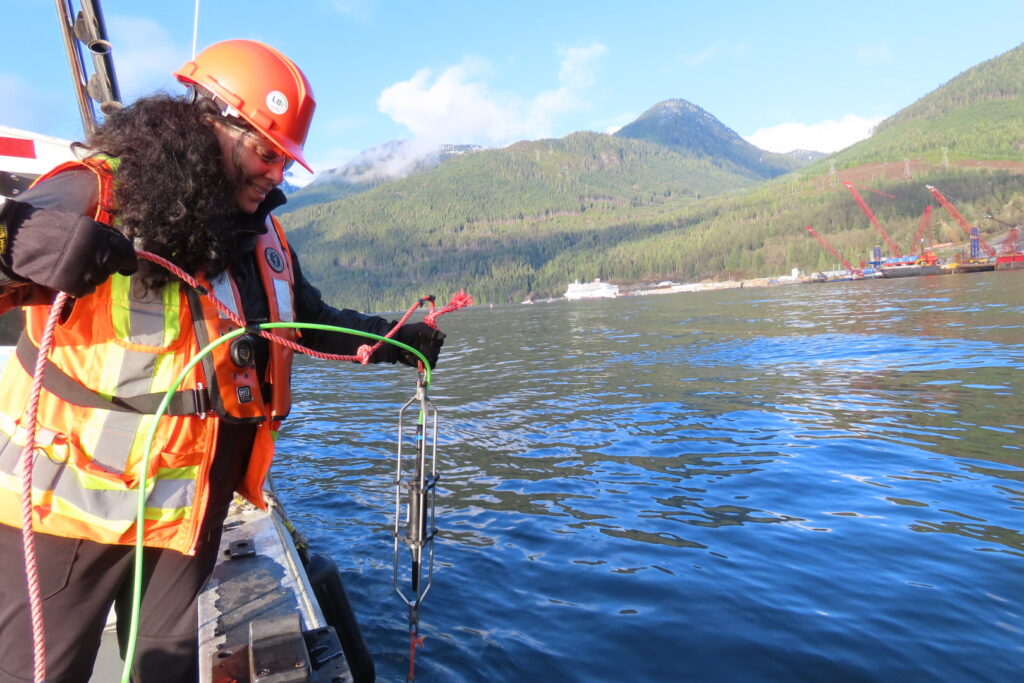
The Marine Mammal Monitoring Program (MMMP) is multi‑disciplinary: a blended team of MMOs, hydroacoustic analysts, data scientists and Indigenous monitors that annually logs thousands of observation hours, hundreds of individual marine mammal sightings, and numerous work stoppages when animals entered exclusion zones. Operationally, the program uses both automated PAM detection and human verification to reduce false positives and to ensure mitigation strategies are started within minutes of detection. With 15 observation posts, seven hydroacoustic monitors, six patrolling boats and more than 5,700 man-hours during the 2024-2025 six-month marine construction season, the MMMP never sleeps.
The MMMP is flexible and responds to real-world data. By tracking and observing how local animals behave—such as identifying individual harbour seals by their photos and tracking when herring spawn or young salmon migrate—the program can adjust where work is restricted, when construction can proceed, and better understand the total long-term impact construction could have on the environment. All monitoring data is archived and available for independent review. Using construction technologies that reduce impact, real-time acoustic and visual monitoring, and a flexible, evidence-based approach to mitigation, the program helps safeguard Howe Sound’s recovering ecosystem while enabling marine construction to progress safely.
Point 4: Net‑Zero
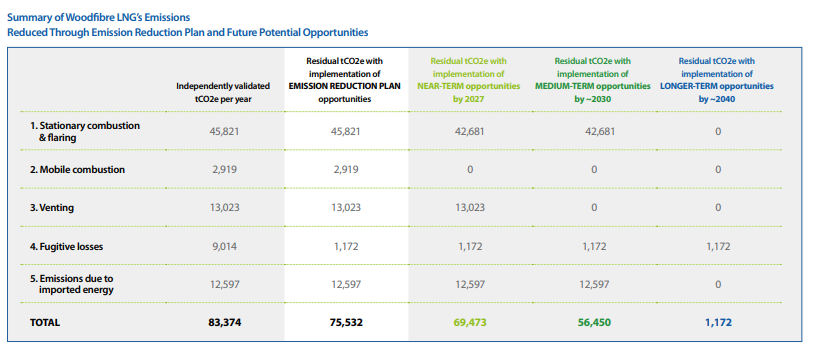
Woodfibre LNG’s net‑zero claim is founded on an explicit, quantifiable hierarchy of interventions: avoid where possible (design choices), reduce aggressively (through best available techniques and operations), measure, report and verify (MRV), and retire the remaining hard‑to‑abate emissions via high‑integrity offsets. Practically, this means:
- Scope‑1 and Scope‑2 minimisation through design: the E‑Drive capabilities remove the largest stationary combustion source
- Process‑level abatement: boil-off gas (BOG) re‑liquefaction and recycling for thermal duties, using compressor dry‑gas seals to cut methane leakage, recycle lines to reduce blowdown and upset flaring
- Operational controls: monthly LDAR surveys with Optical Gas Imaging cameras allow inspectors to check thousands of components and see potential gas leaks in real-time.
- Systems engineering: air‑cooled heat exchangers to avoid seawater thermal discharge impacts and an on‑site low‑purity nitrogen plant to eliminate supply chain transport emissions.
On the MRV front, Woodfibre LNG aligns with Western Climate Initiative (WCI) methodologies and the International Group of Liquefied Natural Gas Importers (GIIGNL) GHG Neutral Framework for cargo‑level claims.
For the residual hard‑to‑abate emissions — those that cannot be eliminated through design, electrification, or operational efficiency measures — Woodfibre LNG implements a robust offsetting strategy focused on high‑integrity, nature‑based carbon credits. To date, Woodfibre LNG has procured over 13,000 tonnes of independently verified carbon offsets, specifically designated to offset the onsite Scope 1 and 2 emissions generated in the construction phase. These credits are sourced from local initiatives such as the Cheakamus Community Forest (CCF) and the BigCoast Forest Climate Initiative.
Both partnerships prioritise projects that not only sequester carbon but also deliver quantifiable co-benefits, like biodiversity enhancement, watershed protection, and economic reconciliation with First Nations partners. The selection criteria for these offsets focus on durability, additionality (ensuring reductions go beyond business‑as‑usual scenarios), and transparent MRV protocols to comply with established frameworks like the BC Emissions Offset Regulation and the GIIGNL GHG Neutral Framework.
Conclusion
Woodfibre LNG’s net‑zero roadmap is not made possible by a single technology but an engineered system: electrification and process design to avoid emissions, advanced seals/BOG/LDAR to reduce methane and flare volumes, rigorous MRV to measure performance, and verified local offsets to neutralise the remaining, hard‑to‑abate tonnes, together form the pathway through which the project seeks to deliver the first operational net‑zero (Scope‑1 & 2) LNG export facility.
Woodfibre LNG illustrates how project design decisions made early can materially shape environmental outcomes. Decarbonisation and habitat preservation are not treated as nice-to-have; they are core elements of the facility’s engineering and operating philosophy. The project is living proof that facilities can be designed to align commercial objectives with significantly lower operational emissions and heightened environmental stewardship.

Blog

Blog